Waterjet or Laser? How to Pick the Right Cutting Process
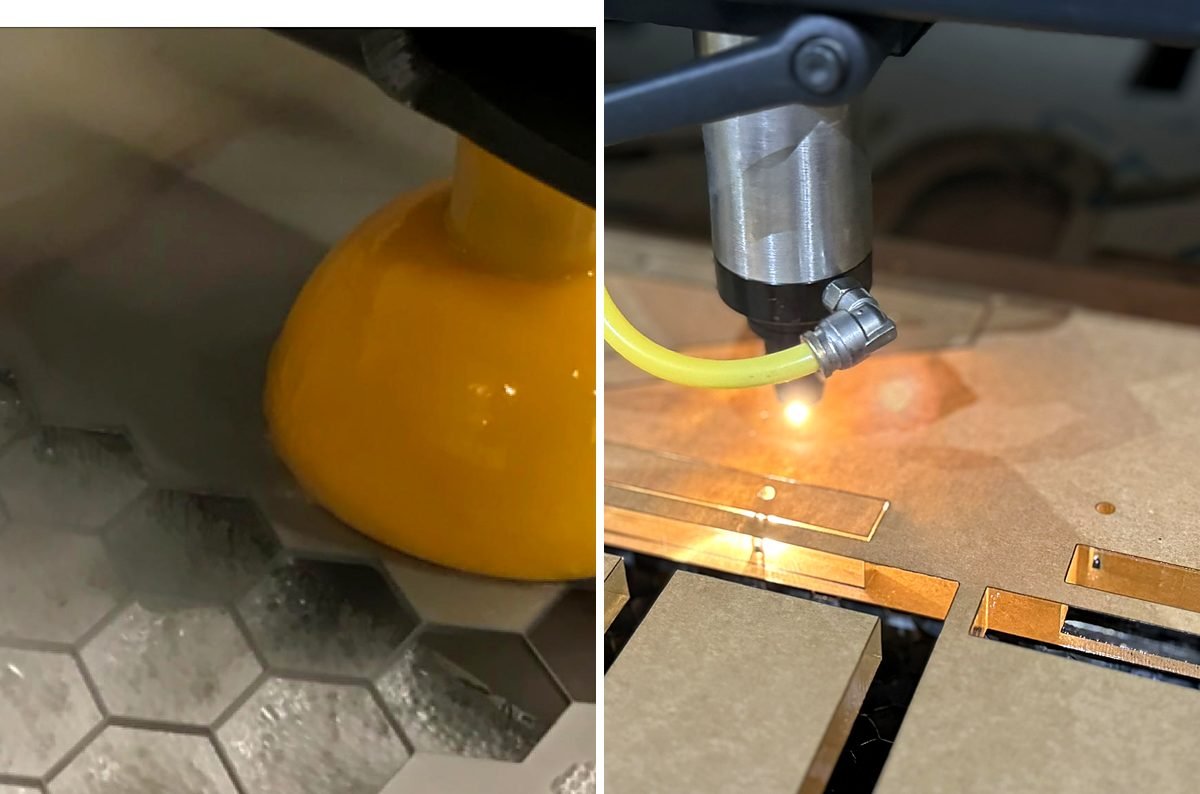
Both machines cut flat parts from the same CAD file, but they get there in completely different ways, and picking the right one saves money, time, and redesigns. This is the full decision in plain terms, built on ACP's published specs, so you can choose per part instead of guessing.
The short version: thickness and heat decide most jobs, material and edge finish decide the rest, and a shop that runs both processes lets you match each part to the machine that suits it. Below, each of those factors gets its own section, with the numbers you can quote against.
Two ways to cut the same file
A fiber laser focuses an intense beam to a tiny point that melts and blows a narrow path through metal. It is fast, precise, and clean on sheet and light plate. ACP's fiber laser cuts steel, stainless, and aluminum, and a separate Kern CO2 laser handles acrylic.
A waterjet mixes fine garnet abrasive into a high pressure stream of water and erodes its way through the material. Nothing melts. The workpiece stays near room temperature from start to finish, which is why waterjet reaches materials and thicknesses a laser cannot, and leaves no heat affected zone behind.
The comparison at a glance
| Factor | Laser | Waterjet |
|---|---|---|
| How it cuts | A focused beam melts a narrow path | Abrasive garnet and water erode it cold |
| Thickness reach | Steel to 0.625″, stainless to 0.250″, aluminum, nickel, and titanium to 0.250″ | 0.005″ foil up to 4.00″ plate |
| Heat | A small heat affected zone at the edge | None, stays near room temperature |
| Materials | Steel, stainless, aluminum, plus acrylic, Delrin, and Teflon | Nearly anything, including G10/FR4, carbon fiber, rubber, gasket, and stone, not glass |
| Edge quality | Crisp, square edge on sheet and light plate | Smooth satin edge, slight taper on thick plate |
| Speed | Very fast on thin material | Steady and slower, unaffected by reflectivity |
| Cost | Lower on thin parts within its range | Often the economical or only choice on thick and heat sensitive parts |
The rest of this guide walks each row so you know why the answer lands where it does.
Start with thickness
The clearest dividing line is how thick your material is. ACP's laser runs steel up to 0.625″, stainless up to 0.250″, and aluminum, nickel alloys, and titanium up to 0.250″. The waterjet cuts everything from 0.005″ foil up to 4.00″ plate.
Under those laser limits, the laser is usually the faster, cheaper choice. Above them, the waterjet is not just better, it is the only option in the building. If your plate is anywhere near the ceiling, read cutting thick metal, where waterjet pulls ahead for the full picture on thick cuts.
Then think about heat
Laser cutting melts material, which leaves a small heat affected zone along the edge. For most brackets and panels that band is irrelevant. But if the part is heat treated, will be welded right at the cut edge, or its temper matters, the waterjet's cold erosion leaves the structure completely intact, with no hardening and no discoloration.
This one property sends a lot of parts to the waterjet on its own. The full explanation of what a heat affected zone is and when it changes a part lives in why waterjet leaves no heat affected zone.
And the material itself
The laser handles common metals and a short list of approved plastics: acrylic, Delrin, and Teflon. The waterjet cuts almost anything, including G10/FR4, carbon fiber, rubber, gasket stock, and stone, with glass being the one notable exception.
- Reflective metals like copper and brass fight a laser but cut fine on the waterjet.
- Composites and anything that produces toxic fumes when burned should always go to the waterjet.
- Gasket, rubber, and stone are waterjet only, because they do not respond well to a melting process.
For the complete shelf of what ACP cuts and stocks, see the Materials reference.
Edge quality and kerf
Both processes remove a thin line of material as they cut, called the kerf. The laser kerf is narrow and the waterjet kerf is wider, but you design to the finished nominal geometry either way. ACP's CAM offsets the toolpath by half the kerf automatically, so the part comes out to the size you drew.
On thick plate a waterjet edge shows a very slight taper, wider at the top than the bottom, and some fine striations lower on the wall. On structural and mounting parts this is invisible in use. The mechanics of kerf and how it shapes small features are covered in kerf explained.
Speed and cost
On thin material the laser is far faster, and faster usually means cheaper, so thin brackets, panels, and covers within the laser range price best on the laser. As material thickens the laser slows and the waterjet's steady pace becomes competitive, then eventually the waterjet is the only in house option at all.
One clean waterjet setup also beats farming thick plate out to another shop and waiting on it. When you are weighing cutting against machining for a chunkier part, laser cutting vs CNC machining lays out where each makes sense.
Tolerances are the same target
Process choice does not change the standard tolerance you can expect. For parts up to 24″ × 24″, ACP holds ±0.010″ on outside profiles and large cutouts and ±0.005″ on holes, adding ±0.002″ to the profile for each extra 12″ beyond 24″. Tighter than that routes to a custom quote. The full breakdown is in what tolerances to expect.
The honest answer: sometimes both
Plenty of jobs at ACP run the laser for the thin parts and the waterjet for the thick or heat sensitive ones, same purchase order, same box. That is the advantage of a shop with both processes under one roof: you do not pick a vendor, you pick per part, and every metal runs on the fiber laser, waterjet, and press brake in the same building.
Quick checklist
- Within the laser thickness range and edge not heat sensitive: laser
- Thicker than the laser can reach, up to 4.00″ plate: waterjet
- Heat treated, welded at the edge, or temper critical: waterjet
- Reflective copper or brass, composites, gasket, or stone: waterjet
- Thin steel or aluminum brackets and panels: laser for speed and cost
- Draw to nominal, keep a small inside corner radius, let CAM handle kerf
- Need tighter than ±0.005″ on holes: flag it for a custom quote