Cutting Thick Metal: Where Waterjet Pulls Ahead of Laser
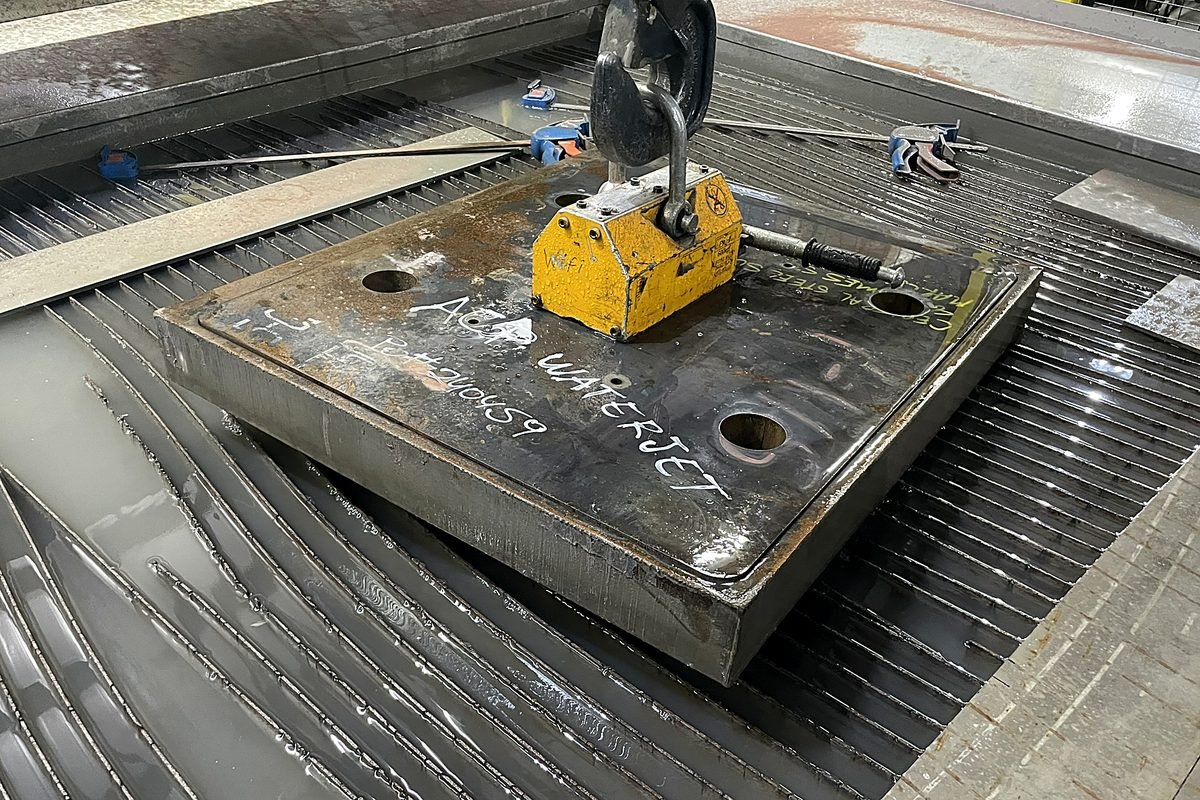
Every cutting process has a ceiling. Ask a shop to cut three quarter inch plate and the honest ones tell you which machine is even in the conversation. This guide draws that line clearly, so you know before you order which process fits your plate and what to expect from the edge.
The takeaway up front: the laser is fast and clean up to a point, the waterjet keeps going far past it, and the always in stock ranges tell you what cuts quickly versus what needs a custom quote.
Laser has a thickness ceiling
A fiber laser is fast and clean on sheet and light plate. As material gets thicker the cut slows down, the edge quality falls off, and eventually the beam cannot get through cleanly at all. Past a certain thickness the laser is the wrong tool even when it technically fits.
In numbers, ACP's laser runs steel up to 0.625″, stainless up to 0.250″, and aluminum, nickel alloys, and titanium up to 0.250″. Those are the practical ceilings. Below them the laser is usually the faster, cheaper choice, and that trade is covered in full in waterjet or laser, how to pick the right cutting process.
Waterjet does not hit that wall the same way
Abrasive waterjet erodes its way through material, so thicker plate simply means a slower pass, not a worse result. It cuts everything from 0.005″ foil up to 4.00″ plate, far beyond anything a laser can reach, and holds a usable edge the whole way through.
There is a second reason thick and critical parts favor the waterjet: it cuts cold, with no heat affected zone. On heavy plate that means no burnt edge and no rehardened skin to deal with afterward. The full story on that is in why waterjet leaves no heat affected zone.
What ACP keeps on the shelf
For fast turn work, ACP holds an always in stock program on 48″ × 48″ blanks. Those ranges are the practical guide to what cuts quickly. Thickness is nominal and follows mill tolerance.
| Material | Stock range |
|---|---|
| Carbon steel | 0.024″ to 1″ |
| G90 galvanized | 18 to 11 gauge |
| 6061-T6 aluminum | 0.032″ to 1″ |
| 5052-H32 aluminum | 0.040″ to 1/4″ |
| 304 stainless | 0.030″ to 1/2″ |
| 316 stainless | 0.060″ to 1/2″ |
| Clear cast acrylic | 1/8″ to 1/2″ |
Thicker plate and other materials can be sourced on a custom quote, where an estimator confirms the right stock and process. The complete shelf lives on the Materials reference.
Edge quality on thick cuts
On thick plate a waterjet edge shows a very slight taper, wider at the top than the bottom, and some fine striations lower on the wall. This comes from the jet losing a little energy as it travels down through the material. For structural and mounting parts it is invisible in use.
Keep a small radius on inside corners rather than a perfectly sharp point, since the jet has width and cannot turn a zero radius corner. Draw the part to nominal and let the CAM handle the kerf offset. The mechanics of kerf on thicker material are covered in kerf explained.
Tolerances on larger plate
Thick does not mean loose. For parts up to 24″ × 24″, ACP holds ±0.010″ on outside profiles and large cutouts and ±0.005″ on holes. As parts get bigger, add ±0.002″ to the profile tolerance for each extra 12″ beyond 24″, and tighter than standard routes to a custom quote. The full breakdown is in what tolerances to expect.
Thick parts and forming
If your thick part also needs a bend, the forming limits matter as much as the cutting ones. ACP forms on TRUMPF TruBend press brakes across a standard thickness range of 0.020″ to 0.500″, so a plate cut thicker than 0.500″ is generally a flat part rather than a formed one. Standard forming tolerances are ±0.030″ on flange dimensions and ±1° on bend angles.
The inside radius comes from the closest available tooling for your material and thickness, and thicker stock naturally wants a larger radius. If a radius is functionally critical, flag it before ordering. For the full forming picture, see designing sheet metal parts that bend right and the press brake bending guidelines.
The cost logic
Thin parts favor the laser on speed. Thick parts often make the waterjet the only in house option, and one clean setup beats farming plate out to another shop and waiting on it. When a job mixes thin and thick parts, running each on the right machine in the same building is both faster and cheaper.
If the decision is really cutting versus machining a solid block, weigh it in laser cutting vs CNC machining before committing to either.
When to request a custom quote
Reach for a custom quote when the plate goes past the stock program:
- Thickness beyond a stocked range, up to the waterjet's 4.00″ plate capacity.
- A material or alloy that is not on the shelf.
- A truly square wall, tighter than standard tolerance, or special edge finish on heavy plate.
An estimator confirms the right stock and process before you order, so the thick part is right the first time.
Quick checklist
- Steel over 0.625″, stainless over 0.250″, aluminum over 0.250″: waterjet
- Up to 4.00″ plate: waterjet keeps a usable edge
- Expect a slight taper and striations on thick cuts, invisible on most parts
- Need a square wall: flag it before the part is cut
- Keep a small inside corner radius, draw to nominal, let CAM handle kerf
- Beyond a stocked range or tighter than standard: custom quote