Is Laser Cutting Cheaper Than CNC Machining?
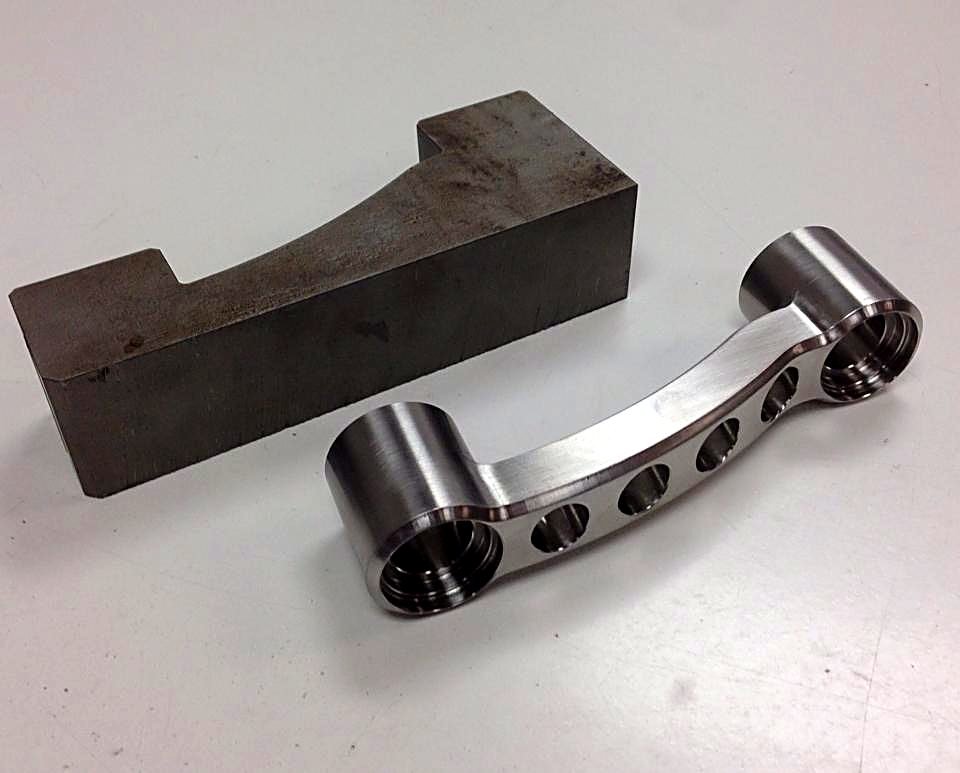
If your part is essentially a flat profile with holes in it, machining it out of solid plate is often the expensive way to make it. Cutting and machining are not competing versions of the same job. They remove material in completely different ways, and that difference decides the price. This guide gives you the honest comparison, shows you which process fits which part, and points out the design swaps that let a cut part quietly replace a machined one.
The core difference in how material comes off
Laser and waterjet cutting remove a thin line of material to free a two dimensional profile out of flat sheet or plate. The beam or the abrasive stream travels around your outline and any internal holes, and the part drops out in seconds to a few minutes. Nothing touches the faces of the material. See Laser Cutting for how the process runs day to day.
CNC milling works the opposite way. A rotating tool carves material away, usually over many passes, to leave the shape behind. You pay for machine time, for tooling, and for the setup that fixtures the block and defines every pass. For a genuine three dimensional part that time is well spent. For a flat profile it is time spent making a shape a cut could have produced in one pass.
What cheaper actually means here
The cost gap is not a small percentage, it is a different order of cost, and it comes from three places:
- Setup. A cut part is nested and run from your file. A machined part needs fixturing, tool selection, and a program that plans each pass.
- Tooling. Cutting has no cutting tool to wear or change. Milling burns through end mills, especially in hard material and thick sections.
- Machine time. Freeing a profile is fast. Removing the same material with a spinning tool over many passes is not.
Add up those three and a flat part that machines in an hour can cut in a fraction of the time, which is why the price separates so sharply.
When cutting wins
Cutting is the cheaper path for anything that is fundamentally flat: brackets, plates, gussets, panels, gaskets, mounting rails, any profile built from holes and slots. On the machines ACP runs, a part up to 24″ × 24″ holds ±0.010″ on outside profiles and large cutouts and ±0.005″ on holes, which covers the vast majority of flat hardware. Add bending and tapping and you have a finished sheet metal part for a fraction of what the same shape would cost milled from a block.
When machining wins
Machining earns its cost on true three dimensional work that cutting cannot produce. Reach for it when the part actually needs:
- Pockets, steps, or contoured faces milled into a solid
- Bosses and raised features that stand off the surface
- Threads tapped directly into a thick section
- Tight flatness or parallelism held across a thick block
If the part is genuinely a solid chunk of metal with features on more than one plane, machine it. Cutting frees a profile, it does not sculpt a solid, and forcing a 3D part onto a cutter just moves the cost somewhere else.
Design so cutting is enough
Here is where most of the savings hide. Many parts arrive as machined blocks that are really cut and formed parts in disguise. A few common swaps move the work from expensive tool time to cheap cut time:
- Milled pocket becomes a cut through hole plus a backing plate. Instead of hogging out a recess, cut the opening clean through one plate and cap it with a second cut plate. Two fast profiles replace hours of milling.
- Machined boss becomes press in hardware. A raised standoff or threaded boss milled from solid can often be replaced by a press in nut or standoff installed after cutting. See designing with press in hardware and Hardware Insertion.
- Solid block enclosure becomes a bent sheet metal box. A housing carved from a billet is usually a folded part waiting to happen. Cut the flat blank, bend it up, and you replace a solid with a light formed shell. See Sheet Metal Bending.
- One thick machined part becomes two cut plates that bolt together. Splitting a complex solid into stacked or bolted flat pieces keeps every piece on the cutter.
Each swap trades machine passes for a fast cut and a simple secondary operation. For threads, plan them as a selected operation rather than milled features. See designing parts for tapping and Tapping.
Where the two processes meet
Plenty of parts want a bit of both. A cut and formed bracket that needs one precision bore, or a plate that needs a milled step on one edge, can start on the cutter and finish with a small machining step. The point is not to pick a side for the whole part, it is to keep the flat, high volume material removal on the cutter, where it is cheap, and reserve machining for the few features that genuinely need it.
When a part crosses that line, it usually moves to a custom quote so an estimator can confirm the right mix of processes before you order.
The overflow angle
There is a version of this decision that happens inside shops that already own a mill. Machinists regularly send us flat plate profiles that were tying up a machine they needed for real three dimensional work. Cutting the flat parts on a laser or waterjet frees the mill for the jobs only a mill can do, and the flat parts come back faster and cheaper than they would have machined. It is usually a win on both sides of the job. See manufacturing overflow for how that fits into a busy shop.
Quick decision checklist
- Flat profile with holes, slots, or notches: cut it
- Needs bends: cut the blank and form it, no machining
- Needs threads or standoffs: add tapping or press in hardware after cutting
- True pocket, boss, or contour on a solid: machine it
- Threads deep in a thick section or tight flatness on a block: machine it
- Mostly flat with one precision feature: cut, then a small machining step
- Not sure: send it to a custom quote and let an estimator confirm